

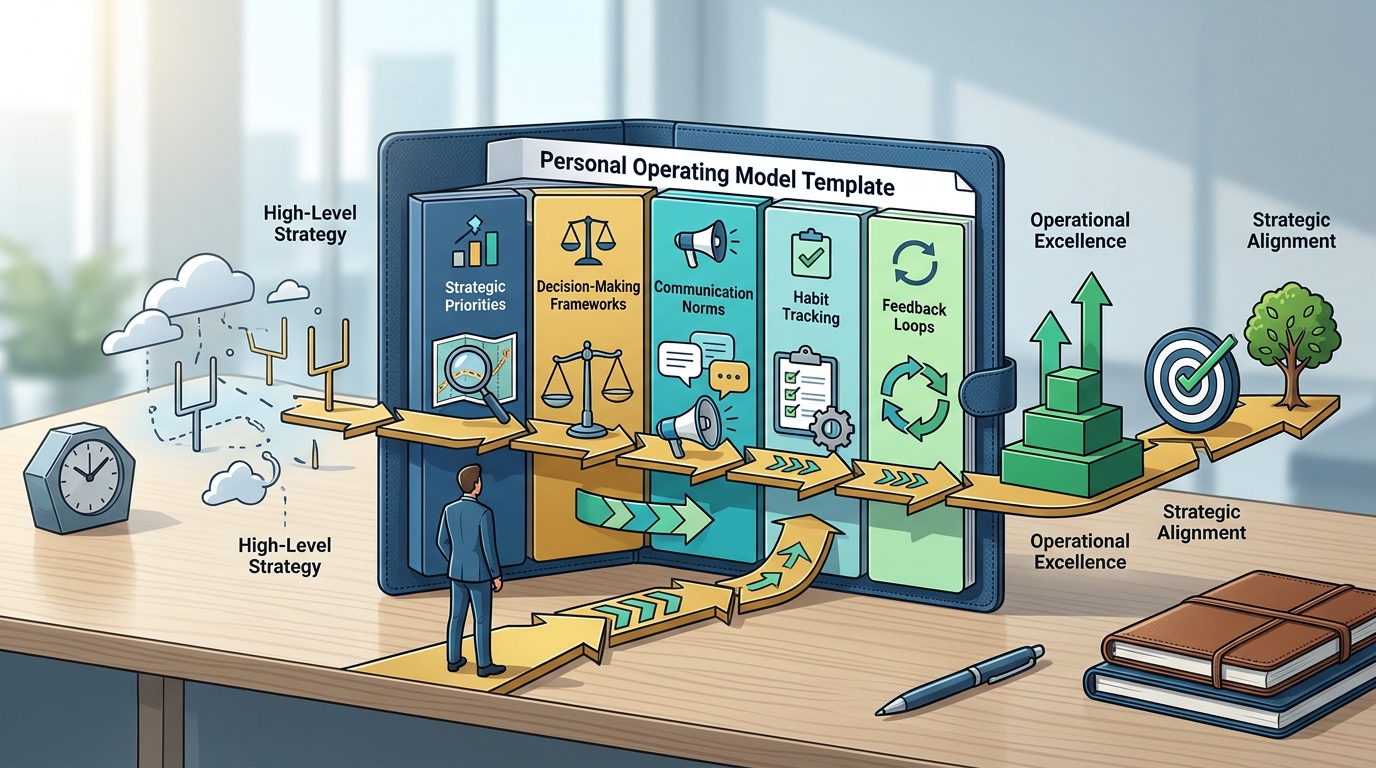
A personal operating model is a structured framework that defines how a leader thinks, decides, and acts. It transforms abstract leadership goals into a repeatable system of habits, priorities, and communication norms. OptiModel provides this template to help executives bridge the gap between high-level strategy and daily execution. This guide covers the five core components of a robust operating model: priorities, delegation, decision rules, energy management, and communication.
Priorities and Mandate
Every effective leader must first define their mandate. A mandate is the specific scope of authority and responsibility assigned to a role. Without a clear mandate, leaders drift into reactive mode, solving problems that belong to other functions. The first step in building your operating model is to articulate your top three to five strategic priorities for the year. These priorities should align with the broader organizational goals but remain specific enough to guide daily choices.
Defining Strategic Focus
Strategic focus is the ability to say no to good ideas in order to say yes to great ones. Leaders often suffer from priority overload, where every stakeholder request feels urgent. To combat this, use a prioritization matrix that categorizes tasks by impact and urgency. This ensures that your time is spent on high-leverage activities that drive measurable outcomes. OptiModel emphasizes that clarity in priorities is the foundation of all other operational excellence.
Aligning with Organizational Goals
Role and Delegation
Delegation is not simply assigning tasks; it is a transfer of ownership. A leader's role is to create an environment where others can succeed without constant supervision. Many leaders struggle with delegation because they confuse their role with their former individual contributor responsibilities. You must shift from doing the work to designing the system that produces the work. This shift is critical for scaling your impact beyond your immediate team.
The Delegation Framework
Effective delegation requires clarity on three elements: the outcome, the constraints, and the decision rights. When you delegate, specify what success looks like, what resources are available, and where the delegate has autonomy versus where they must consult you. This reduces the need for micromanagement and builds trust. The Accountability Without Micromanagement guide provides practical methods for setting these boundaries.
Building a Delegation Culture
A culture of delegation is built through consistent practice. Start by delegating low-risk tasks to build confidence, then gradually increase the complexity of the responsibilities you assign. This approach helps your team develop the skills necessary to handle higher-stakes decisions. By intentionally stepping back, you free up your own capacity for strategic thinking and relationship building.
Decision Making Rules
Decision making is the core function of leadership. A decision rule is a predefined criterion that guides how choices are made when information is incomplete. Leaders who lack clear decision rules often experience analysis paralysis or make inconsistent choices. By establishing explicit rules, you create a predictable and transparent process that builds trust with your team and stakeholders. This consistency is essential for maintaining momentum in fast-paced environments.
Types of Decisions
Not all decisions require the same level of deliberation. Classify decisions into three categories: reversible, irreversible, and high-impact. Reversible decisions should be made quickly with 70% of the information. Irreversible decisions require deeper analysis and broader consultation. High-impact decisions may require a formal review process. This classification system prevents you from overthinking minor issues while ensuring rigor for critical choices.
Implementing Decision Protocols
Document your decision protocols so that your team understands how you operate. This transparency reduces anxiety and allows others to make decisions in your absence. Use frameworks like the OKR Framework to align decision outcomes with key results. When your decision rules are clear, you can delegate more effectively because your team knows what you value and how you evaluate options.
Energy Management
Energy management is the practice of directing your physical, emotional, mental, and spiritual resources to sustain high performance. Time management is about doing more in less time; energy management is about doing the right things with the right intensity. Leaders who ignore energy management often burn out, leading to poor decision making and reduced empathy. Your operating model must include specific strategies for recharging and maintaining resilience over the long term.
Identifying Energy Leaks
Conduct an energy audit to identify activities that drain you versus those that energize you. Common energy leaks include excessive meetings, unclear expectations, and emotional labor. Once identified, you can mitigate these leaks by setting boundaries, delegating, or restructuring your workflow. The Resilience in Action guide offers tools for navigating challenge and change with clarity and strength.
Building Sustainable Rhythms
Design your workday around your natural energy peaks. Schedule deep work during your highest energy periods and administrative tasks during lower energy windows. Incorporate regular breaks and recovery time into your calendar. This intentional design prevents burnout and ensures that you can sustain high performance over months and years, not just weeks. Consistency in energy management is a key differentiator for effective leaders.
Communication Norms
Communication norms are the agreed-upon standards for how information is shared and received within a team. Clear communication norms reduce friction and increase psychological safety. They define how feedback is given, how conflicts are resolved, and how decisions are communicated. By establishing these norms explicitly, you create a predictable environment where people feel safe to speak up and share their true thoughts.
Feedback and Dialogue
Feedback is a critical component of high-performing teams. Establish norms that encourage constructive, timely, and specific feedback. Create a culture where feedback is viewed as a gift rather than a criticism. The Feedback That Fuels Growth guide provides a framework for turning feedback into measurable progress. When feedback is normalized, teams learn faster and adapt more effectively to changing conditions.
Transparency and Trust
Transparency is the foundation of trust. Share information proactively, even when it is uncomfortable. This includes sharing challenges, setbacks, and uncertainties. When leaders are transparent, they build credibility and foster a culture of honesty. Use the Have Meaningful Conversations guide to elevate everyday communication into purposeful connection. These norms ensure that your team operates with integrity and consistency.
Key Takeaways
- A personal operating model is a structured framework that defines how a leader thinks, decides, and acts.
- Clear priorities and a defined mandate prevent reactive behavior and ensure strategic focus.
- Delegation is a transfer of ownership, not just task assignment, and requires clarity on outcomes and decision rights.
- Decision rules provide consistency and transparency, reducing analysis paralysis and building trust.
- Energy management is essential for sustaining high performance and preventing burnout.
- Communication norms create psychological safety and foster a culture of feedback and transparency.
- OptiModel provides practical tools and frameworks to help leaders build and refine their operating models.
- Regular review and adjustment of your operating model ensure it remains aligned with your evolving goals and context.
Frequently Asked Questions
What is a personal operating model?
A personal operating model is a tailored framework that empowers you to navigate your life with clarity, purpose, and efficiency. It is a strategic blend of habits, principles, and routines that reflect your values, goals, and aspirations.
How do I start building my operating model?
Begin by defining your top three to five strategic priorities. Then, establish your decision rules and communication norms. Use tools like the 90 Day Leader Playbook to structure your initial phase of leadership.
Why is delegation important for leaders?
Delegation allows leaders to scale their impact beyond their immediate team. It builds trust and develops the skills of your team members, creating a more resilient and capable organization.
How can I manage my energy effectively?
Conduct an energy audit to identify drains and energizers. Schedule deep work during your peak energy periods and incorporate regular breaks into your calendar. Use the Focus in the Age of Distraction guide to reclaim clarity and concentration.
What are communication norms?
Communication norms are the agreed-upon standards for how information is shared and received within a team. They define how feedback is given, how conflicts are resolved, and how decisions are communicated.
How often should I review my operating model?
Review your operating model quarterly to ensure it remains aligned with your evolving goals and context. Use the Culture Health Diagnostic to track trends in your team's culture and performance.
Conclusion
Building a personal operating model is a continuous process of refinement and adaptation. By defining your priorities, mastering delegation, establishing decision rules, managing your energy, and setting clear communication norms, you create a system that supports consistent high performance. OptiModel provides the tools and frameworks you need to design your own model, tailored to your values, goals, and environment. To begin your journey, book a free introductory consultation with our advisory team.