

Working with an experienced leadership advisor means engaging a strategic partner who provides direct, honest feedback and practical frameworks rather than generic motivational talk. You should expect a structured process focused on specific outcomes, such as clarifying complex decisions or building high-performance team systems. The relationship is built on confidentiality and a commitment to actionable results that you can implement immediately.
The Core Philosophy of Strategic Clarity
At the heart of effective advisory is the belief that success should be intentional, not accidental. Strategic intelligence is the ability to navigate complex business environments by aligning values with action and maintaining operational consistency. Many leaders struggle because they react to daily pressures rather than operating from a defined system. An experienced advisor helps you design a Personal Operating Model, which is a tailored framework that harmonizes your ambitions with your daily routines and decision-making processes.
This approach moves beyond surface-level coaching. It digs into the underlying systems that drive your performance. For example, a leader might feel overwhelmed by a new mandate. Instead of offering vague encouragement, an advisor will help you map out the specific levers of influence you control. This ensures that your energy is directed toward high-impact activities rather than scattered across low-value tasks. The goal is to create a sustainable rhythm of work that supports both personal well-being and organizational goals.
Directness and Honest Assessment
One of the most distinct characteristics of a high-level leadership advisor is a commitment to honest assessment. You will not receive varnished feedback or corporate hedging. Direct feedback is the practice of communicating difficult truths clearly and respectfully to help a leader recognize blind spots. This is often uncomfortable, but it is essential for growth. An advisor will challenge your assumptions and point out where your actions may be misaligned with your stated values.
This level of candor requires a foundation of trust and confidentiality. Everything shared in sessions remains strictly private, allowing you to discuss sensitive issues without fear of organizational repercussions. For instance, if you are navigating a conflict with a board member or a key executive, the advisor provides a safe space to dissect the dynamics. They help you see the situation from multiple perspectives, ensuring that your response is strategic rather than reactive. This directness is what separates a true strategic partner from a generic coach.
Practical Tools Over Theoretical Models
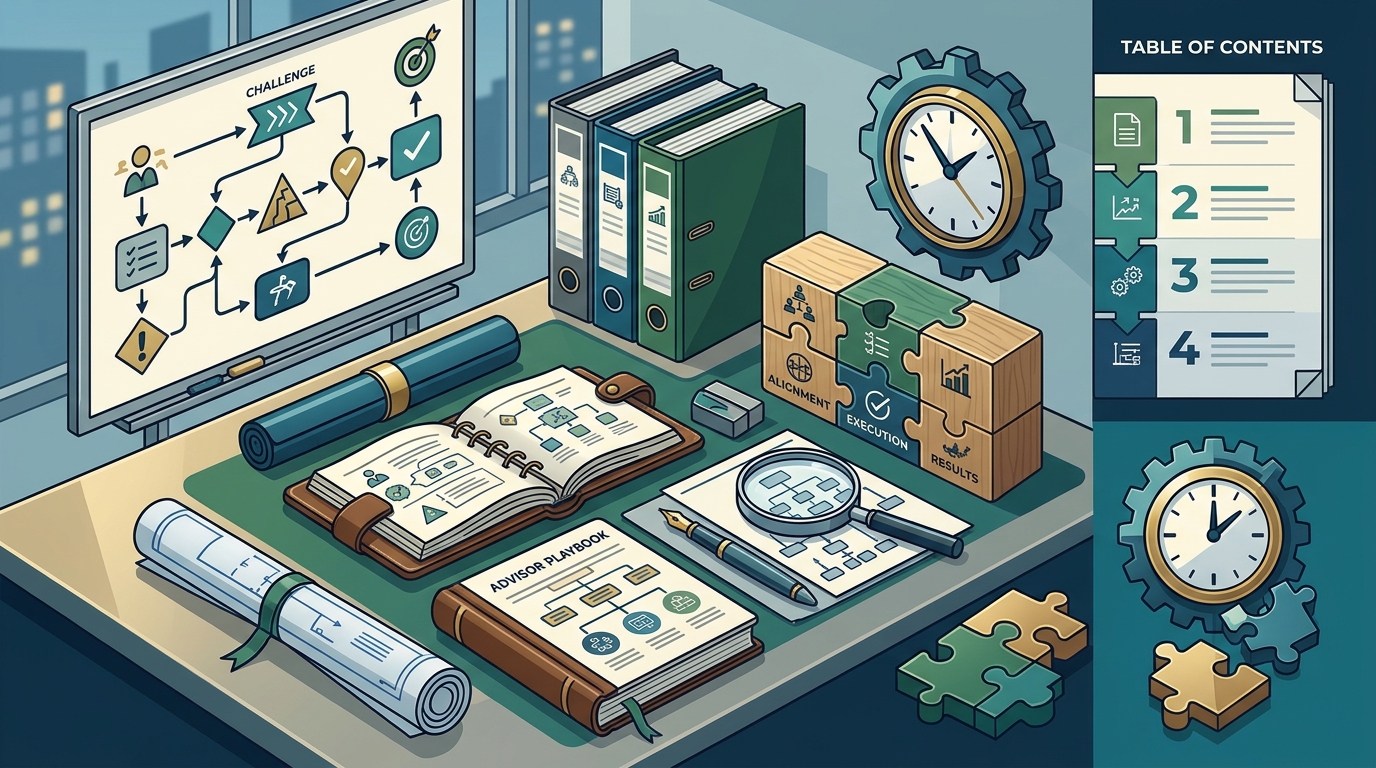
Effective advisory is grounded in real-world experience and backed by actionable systems. You should expect to leave every session with concrete tools you can implement immediately. Practical frameworks are structured templates or models that simplify complex problems into manageable steps. These are not abstract theories; they are designed for execution. For example, an advisor might use a 90 Day Leader Playbook to help you structure your first quarter in a new role. This tool breaks down the initial period into three distinct phases: listening, assessing, and executing.
Another common tool is the Strategic Alignment Map, which helps you connect high-level organizational goals to daily team priorities. By using these specific instruments, you avoid the trap of having a strategy that exists only on paper. The advisor ensures that the plan is translated into clear, owned actions. This bridge between strategy and execution is where most organizations fail, and it is where an experienced advisor adds the most value.
Structured Session Formats and Outcomes
Advisory engagements are typically structured around specific formats designed to address different types of challenges. A common format is the Clarity Worksession, a focused 90-minute session designed to cut through complexity. In this format, you choose a specific challenge, such as a difficult project decision or a presentation that needs sharpening. The session follows a structured agenda that moves from reframing the problem to identifying key decision blocks. You leave with a prioritized shortlist of actions and a written plan.
For leaders who need ongoing support, a retained advisor model provides continuity. This involves regular sessions, such as four per month, combined with asynchronous access for quick questions. This model is ideal for those navigating sustained transformations, such as mergers or rapid scaling. The advisor acts as a sounding board for decisions that are moving in days, not quarters. The outcome is a leader who has a consistent strategic partner in their corner, ensuring that long-term vision is not lost in the daily grind.
Building a Culture of Accountability
Leadership advisory often extends beyond the individual to the teams they lead. A key focus is building a culture where accountability grows from trust rather than control. Accountability without micromanagement is the practice of empowering teams to own their results by setting clear expectations and building transparent systems. An advisor helps you shift from a supervisory role to a facilitative one. This allows your team to perform with integrity and consistency while freeing you from the constant need to check in.
For example, an advisor might guide you through a Team Design Canvas exercise. This tool helps you and your team explicitly define your purpose, roles, and operating norms. By getting these things out of people's heads and into the open, you eliminate the ambiguity that often leads to dysfunction. The result is a team that is genuinely aligned, not just a group of individuals who share a reporting line. This cultural shift is one of the most impactful outcomes of working with an experienced advisor.
Key Takeaways
- Expect direct, honest feedback that challenges your assumptions and highlights blind spots.
- Advisory is built on confidentiality, allowing you to discuss sensitive issues safely.
- You will receive practical frameworks and tools, not just theoretical advice.
- Sessions are structured around specific outcomes, such as a written action plan or a prioritized shortlist.
- The goal is to align your personal values with your daily actions to create a sustainable operating model.
- Advisory helps you build team cultures based on trust and clear expectations rather than micromanagement.
Frequently Asked Questions
How is a leadership advisor different from a coach?
A leadership advisor typically brings deep industry experience and strategic expertise to the table. They provide direct guidance on specific business challenges and help you navigate complex organizational dynamics. A coach, on the other hand, often focuses more on personal development and mindset, using questions to help you find your own answers. An advisor is more likely to provide concrete recommendations and frameworks based on their experience.
How long does an advisory engagement usually last?
It depends on your needs. Some leaders book a single Clarity Session to address a specific, immediate challenge. Others opt for a monthly work session to stay close to their decisions. For those in sustained transformation, a retained advisor model with multiple sessions per month provides the continuity needed for long-term strategic alignment.
What should I prepare before my first session?
You should complete any pre-session intake forms provided by the advisor. This helps them understand your context and priorities before you meet. It is also helpful to define your desired outcome for the session. Do you want to solve a specific problem, get feedback on a plan, or clarify your next steps? Having a clear focus ensures the session is productive.
Is the advice confidential?
Yes. Confidentiality is a cornerstone of the advisory relationship. Everything you share in sessions remains strictly private. This allows you to be open and honest about challenges, conflicts, and uncertainties without worrying about how the information might be perceived within your organization.
Can an advisor help with team dynamics?
Absolutely. A significant part of leadership is managing the people around you. An advisor can help you diagnose team dysfunction, clarify roles, and build a culture of accountability. They can guide you through exercises that help your team align on purpose and operating norms, leading to improved performance and cohesion.
Start Your Strategic Partnership
Working with an experienced leadership advisor is an investment in your clarity and your organization's future. It provides you with the tools, feedback, and strategic support needed to lead with confidence and consistency. If you are ready to move from reactive management to intentional leadership, it is time to explore how advisory can support your goals.
To begin, you can book a free introductory consultation with OptiModel. This is a low-commitment way to discuss your current challenges and determine if a strategic partnership is the right fit for you. OptiModel provides strategic intelligence and on-demand expertise for leaders and organizations, helping you think with precision and execute with confidence.