

For CEOs navigating sustained transformation, a retained advisor is often superior to a project consultant because it provides continuous strategic access rather than episodic fixes. Project consultants are ideal for discrete, time-bound deliverables, while retained advisors suit leaders who need ongoing clarity and direct access. OptiModel structures its retained advisor program specifically for executives who require a thinking partner during high-stakes seasons, ensuring that strategic continuity is maintained without the overhead of a full-time hire.
Understanding the Two Engagement Models
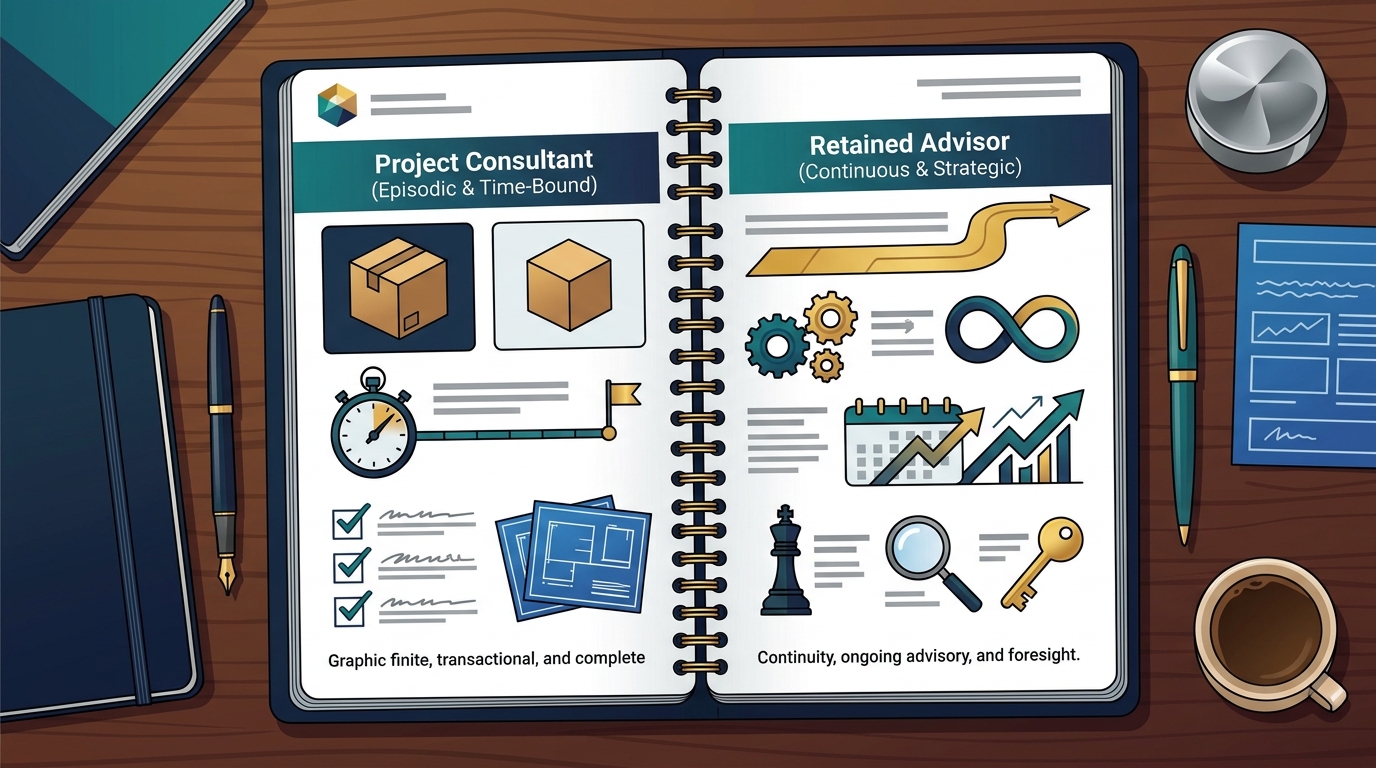
Choosing the right external support depends on the nature of your strategic challenge. A project consultant is an external specialist hired for a specific, bounded scope of work. This model is defined by a clear start and end date, a fixed deliverable, and a defined budget. It is effective when the problem is well-understood and the solution is a tangible output, such as a market analysis or a reorganization plan.
A retained advisor is a strategic partner engaged on an ongoing basis to provide continuous guidance and access. This model is defined by a recurring fee, priority access to the advisor, and a focus on decision-making quality rather than a single deliverable. It is effective when the challenge is complex, evolving, and requires real-time input. The core difference is that a project consultant solves a problem, while a retained advisor improves the quality of your thinking and decision-making over time.
Project Consultant: Strengths and Limits
Project consultants bring specialized expertise to a specific challenge. Their primary strength is depth in a narrow domain. If you need a financial model built or a specific technical audit, a project consultant is the right choice. They work within a defined scope, which keeps costs predictable and outcomes measurable. This approach suits CEOs who face a one-time hurdle, such as preparing for a merger or launching a new product line.
However, project consultants have significant limits. They are not available for the day-to-day decisions that arise after the project ends. Once the contract is fulfilled, the relationship typically dissolves. This creates a gap in strategic continuity. If your organization is undergoing a sustained transformation, a project consultant may provide a snapshot of the problem but cannot accompany you through the execution phase. They are best suited for leaders who need a specific deliverable and have the internal capacity to implement it independently.
Retained Advisor: Strengths and Limits
A retained advisor provides a continuous layer of strategic intelligence. The primary strength is access. You have a dedicated partner who understands your context, your team, and your history. This continuity allows for nuanced feedback that a new consultant, starting from zero, cannot provide. The advisor acts as a sounding board for high-stakes decisions, offering honest assessment and practical tools. This model is ideal for CEOs in sustained transformation, such as rapid scaling or a new leadership mandate, where decisions are made in days, not quarters.
The limit of a retained advisor is that they are not a project delivery team. They do not build the financial model or write the code. Their value is in the quality of the conversation and the clarity of the plan. If you need hands-on execution support, a retained advisor alone is insufficient. This model suits leaders who value directness over politeness and who need a discreet, confidential space to process complex challenges. It is a strategic partnership, not a service transaction.
Comparison of Engagement Models
| Criteria | Project Consultant | Retained Advisor |
|---|---|---|
| Primary Focus | Specific deliverable | Decision-making quality |
| Duration | Fixed term (weeks/months) | Ongoing (monthly/annual) |
| Access | Scoped to project | Priority, direct access |
| Best For | Discrete, bounded problems | Sustained transformation |
| Cost Structure | Fixed fee or hourly | Recurring monthly fee |
| Continuity | Ends at project completion | Continuous relationship |
Choosing the Right Model for Your Needs
Choose a project consultant if you have a specific, well-defined problem that requires a tangible output. This includes tasks like a competitive analysis, a specific process audit, or a one-time strategic plan. If your team has the capacity to implement the recommendations and you do not need ongoing guidance, a project consultant is the efficient choice. It is a transactional relationship with a clear end point.
Choose a retained advisor if you are navigating a period of sustained change. This includes scenarios like a new CEO mandate, rapid scaling, or a complex organizational restructure. If you need a thinking partner who can provide real-time feedback on decisions as they arise, a retained advisor is the better fit. This model provides the continuity and access that episodic consulting cannot. It is a partnership focused on your long-term strategic clarity.
Frequently Asked Questions
Can I switch from a project consultant to a retained advisor?
Yes, many leaders start with a project consultant to address an immediate issue and then transition to a retained advisor for ongoing support. This is a common path when the initial project reveals deeper, systemic challenges that require continuous attention. The transition allows you to leverage the consultant's findings while gaining the strategic continuity of an advisor.
What is the main difference in cost structure?
Project consultants typically charge a fixed fee or an hourly rate for a defined scope. Retained advisors charge a recurring monthly fee that covers a set number of sessions and access. The retained model often provides more value per dollar for ongoing needs because it includes priority access and continuity, which are not available in a standard project engagement.
Is a retained advisor a replacement for a board member?
No, a retained advisor is not a replacement for a board member. Board members have fiduciary duties and governance responsibilities. A retained advisor provides strategic guidance and a confidential sounding board. They complement the board by offering the CEO a direct line to strategic expertise without the formal governance constraints.
How do I know if I need ongoing access?
You need ongoing access if your decisions are high-stakes and frequent. If you are making multiple significant decisions per month that require careful consideration, a retained advisor provides the necessary support. If your decisions are infrequent and well-defined, a project consultant may be sufficient. Assess the frequency and complexity of your decision-making to determine the right model.
Conclusion
The choice between a project consultant and a retained advisor depends on the nature of your strategic challenge. Project consultants are best for discrete, bounded problems, while retained advisors are ideal for sustained transformation and ongoing decision-making. For CEOs who need continuous strategic clarity and direct access, a retained advisor provides the depth and continuity that episodic consulting cannot. OptiModel offers a retained advisor program designed for leaders who want to operate with purpose and precision. To explore how a retained advisor can support your strategic goals, book a free introductory consultation.