

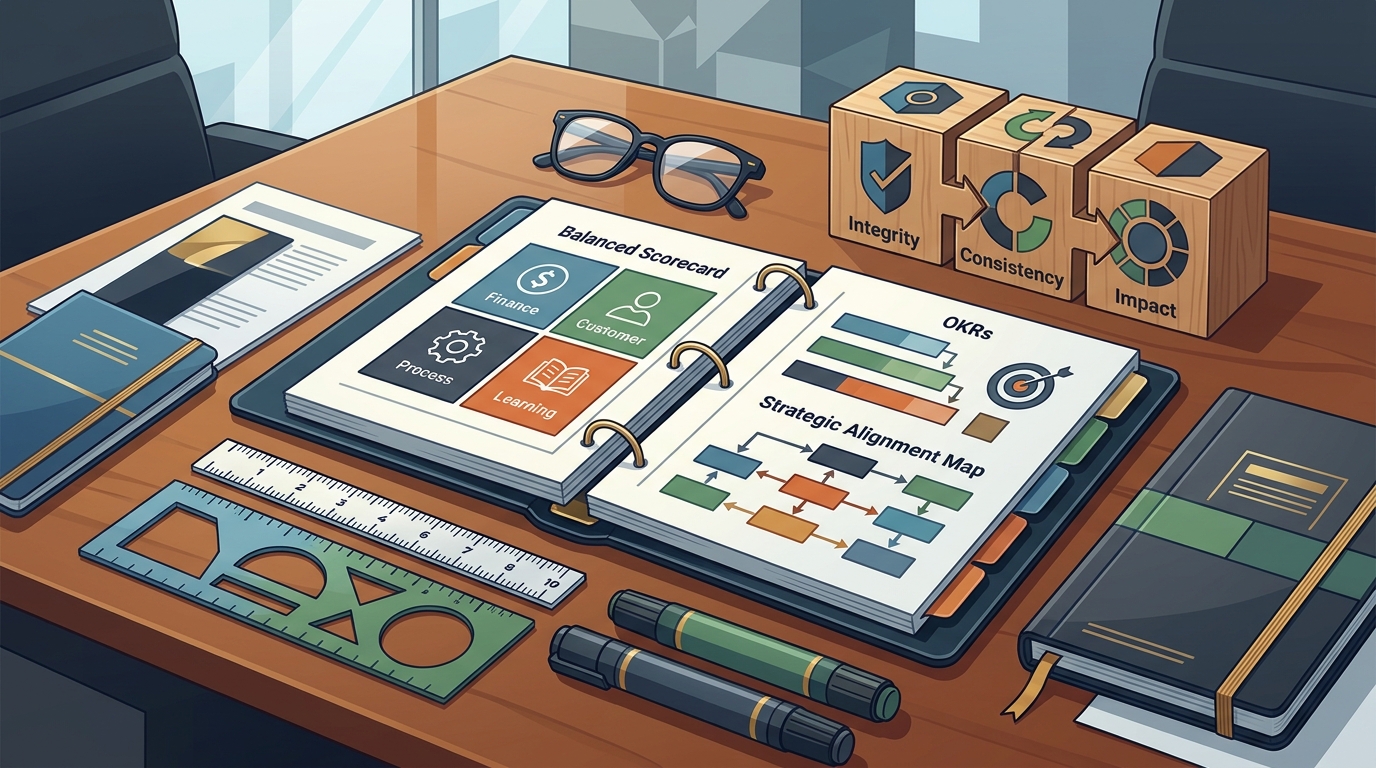
Executive teams use structured frameworks like the Balanced Scorecard, OKRs, and Strategic Alignment Maps to bridge the gap between high-level vision and daily execution. These tools translate abstract goals into measurable actions, ensuring that every team member understands how their work contributes to the organization's success. By adopting these systems, leaders create a visible line of sight from the boardroom to the frontline, reducing misalignment and improving operational consistency.
The Gap Between Strategy and Execution
Strategy is one of the most over-produced and under-executed artifacts in organizational life. Boards commission plans, consultants refine them, and leaders present them, yet organizations often continue doing what they were doing before. This disconnect is not a failure of ambition but a failure of translation. When the strategy on the page does not connect to the work on the desk, execution dies. Leaders must move beyond communication and build a structured process that explicitly connects goals across every level of the organization.
The core issue is that alignment is rarely the outcome of a well-written memo. It is the result of a sustained process where goals are connected until every individual can draw a direct line between their daily tasks and the organizational direction. Without this connection, people make decisions in silos, prioritize incorrectly, and lack the sense of purpose that drives engagement. Strategic Alignment Maps address this by providing a structured approach to cascading strategy with clarity, preserving intent as it moves down through business units and teams.
OKRs: Clarity and Alignment Over Performance Management
Objectives and Key Results (OKRs) is a framework designed to solve the problem of scattered effort. An Objective is a clear, inspiring statement of what you want to achieve, while Key Results are the two to five measurable outcomes that tell you whether you achieved it. This structure forces two critical disciplines: choosing what truly matters and defining what success actually looks like. Andy Grove developed this method at Intel in the 1970s, and John Doerr carried it to Google in 1999, where it helped a startup scale into a global leader.
However, OKRs fail when leaders deploy them as a performance management system. When scores are tied to compensation, people write safe objectives rather than ambitious ones, and the framework becomes bureaucratic overhead. OKRs are not a tool for evaluating people; they are a clarity and alignment tool. Their primary purpose is to ensure that every person in the organization understands the most important things to achieve and can tell, in real time, whether they are working toward them. When this understanding exists at every level, organizations move with a coherence that individual effort alone cannot manufacture.
The Balanced Scorecard: Seeing the Drivers of Performance
Most organizations know their numbers, but very few know their business. Managing by financials alone is like driving by staring at the rearview mirror; you can see where you have been, but not where you are going. The Balanced Scorecard solves this by organizing performance measurement across four distinct perspectives: Financial, Customer, Internal Processes, and Learning & Growth. Financial results are a consequence, not a cause. They flow downstream from choices made about customers, processes, and people.
Robert Kaplan and David Norton introduced this framework in the early 1990s to address the systematic bias toward short-term financial thinking. By measuring the engines of sustained performance, such as loyal customers and efficient processes, leaders gain visibility into the factors that drive long-term health. This approach ensures that today's performance is not just achieved but sustained and improved tomorrow. It provides a complete picture of where the organization stands, how customers experience it, and whether it is building the capability to keep improving.
Culture Diagnostics: The Operating System of the Organization
Culture is the operating system of an organization, running beneath every decision and interaction. It determines how people behave when no one is watching and whether good people stay or quietly leave. Strategy may set the direction, but culture determines whether you actually get there. The difficulty is that culture resists easy measurement. Leaders often describe the culture they intend, but the gap between intention and reality is one of the most consequential gaps in organizational life.
A Culture Diagnostic gives leaders a structured, honest view of cultural reality across critical dimensions. It is not a satisfaction survey but a tool for seeing clearly, which is the prerequisite for acting well. Culture does not deteriorate all at once; it drifts. Trust erodes in small increments until the accumulation becomes a problem that is difficult to reverse. Regular pulse measurement allows leaders to spot slow declines in psychological safety or team cohesion well before they manifest in attrition or performance breakdown.
Team Design: From Proximity to Performance
Most teams are not built; they accumulate. A vacancy opens, someone gets hired, and a reorganization shuffles names across an org chart. Over time, a group of people is called a team, but that label does heavy lifting. What often exists in practice is a collection of individuals who share a reporting line but lack a shared understanding of purpose. That is not a team; that is proximity. A real team, one that is aligned on purpose and clear on roles, consistently outperforms a group of talented individuals working in parallel.
The Team Design Canvas provides a practical framework for the deliberate conversations that turn a group into a team. It addresses the questions that, left unanswered, quietly undermine performance: Why does this team exist? Who does what, and why? How do we relate to one another? By making roles, norms, and operating cadences explicit, leaders reduce friction and accelerate everything. This canvas is most valuable at genuine inflection points, such as when a new leader steps in or a restructure has reshuffled responsibilities.
Key Takeaways
- Alignment is a structured process, not a communication event; it requires explicit connections between individual work and organizational strategy.
- OKRs are a clarity tool, not a performance management system; tying them to compensation undermines their effectiveness.
- The Balanced Scorecard provides visibility into the drivers of financial performance, including customers, processes, and learning capabilities.
- Culture drifts silently; regular diagnostics are necessary to catch erosion in trust and psychological safety before it becomes a crisis.
- Teams must be deliberately designed; proximity and shared reporting lines do not create the alignment needed for high performance.
- Effective frameworks create a visible line of sight, allowing every employee to understand how their contribution fits into the larger picture.
Frequently Asked Questions
What is the primary purpose of OKRs in an executive team?
The primary purpose of OKRs is to create clarity and alignment. They ensure that every person in the organization understands the most important things to achieve and can tell whether their work is contributing to those goals. They are not designed to evaluate individual performance or determine compensation.
How does the Balanced Scorecard differ from traditional financial reporting?
Traditional financial reporting measures what has already happened. The Balanced Scorecard measures the drivers of future performance, including customer satisfaction, internal process efficiency, and organizational learning. It places financial results in context as an outcome of these other factors rather than the sole metric of success.
Why do teams often fail to align with strategy?
Teams fail to align because strategy is often not translated into daily work. If no one makes it clear how the strategy on the page connects to the work on their desk, people continue doing what they were doing before. Alignment requires a sustained process of connecting goals across every level of the organization.
What is a Culture Diagnostic?
A Culture Diagnostic is a structured tool that provides leaders with an honest view of the cultural reality their people are living. It measures dimensions such as trust, conflict handling, and psychological safety to identify gaps between the intended culture and the experienced culture.
How often should leaders run culture diagnostics?
Leaders should run deep culture diagnostics annually to catch significant drift. However, they should also use lighter, more frequent pulse checks quarterly to track trends and identify emerging issues before they become crises. Regular measurement provides the trend data necessary for proactive management.
What is the difference between a team and a group of individuals?
A group of individuals shares a reporting line and attends the same meetings but may lack a shared understanding of purpose and roles. A real team is deliberately designed with explicit alignment on purpose, roles, and operating norms. This design allows the team to perform beyond the sum of its parts.
Conclusion
Executive teams that master strategic alignment do not rely on intuition or ad-hoc communication. They use structured frameworks to create a visible line of sight from the boardroom to the frontline. By implementing tools like OKRs, the Balanced Scorecard, and Team Design Canvases, leaders ensure that strategy is not just planned but executed. OptiModel advisory services provide the strategic intelligence and on-demand expertise needed to operationalize these frameworks effectively. To begin aligning your team with your strategy, explore the OptiModel Knowledge Hub for practical guides and frameworks.